Medan Great Mosque
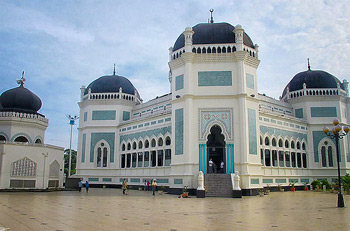
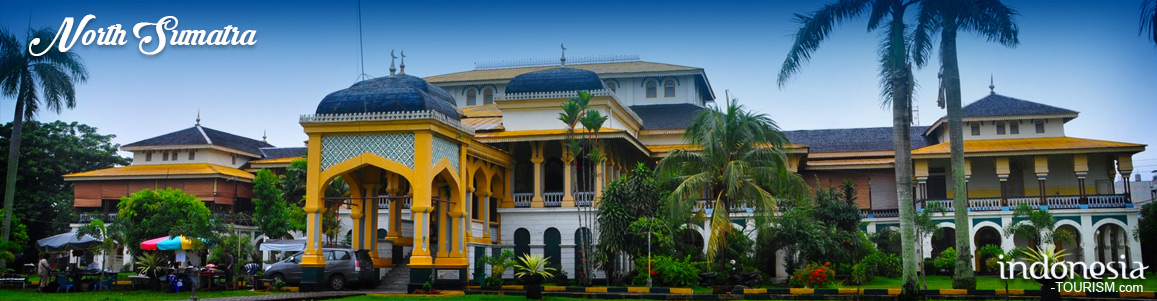
Great Mosque of Medan or Masjid Raya Al Mashun is located at Jalan Singamangaraja, Medan, North Sumatra. It was built in 1906 – 1909, in the style between the Middle East, Spain, and India; it has octagonal shape and has a wing on the south, east, north and west.. The location is very easy to found for it already popular as one of pilgrimage sites in Medan.
In beginning of its establishment, this mosque merges with palace complex, where Sultan Ma'mun Al Rashid Perkasa Alam as a leader of Sultanate of Deli started the development of this mosque.
The first developer of this mosque was designed by the Dutch architect Van Erp who also designed The Maimoon Palace, but then the process was done by JA Tingdeman, for Van Erp at that time was called to Java by the Dutch government to join in the process of restoration of Borobudur temple in Central Java. Most imported building materials such as: marble for decoration imported from Italy, Germany and China and the stained glass from the chandelier directly from France.
The building of this mosque is divided into the main hall, ablution, entrance and tower. The main hall, a place of prayer, the octagonal is not equilateral. The windows that surround the porch door made of wood with precious stained glass, the remnants of the Art Nouveau period 1890-1914, that combined with Islamic art.
The entire ornament in the mosque either on walls, ceilings, pillars, arches and a surface is rich with flowers and plants. In front of each veranda there are stairs. While, the dome of the mosque is re-modeling the Turkish interior, broken shapes octagonal. The main dome surrounded by four other domes above each porch, with a smaller size. The dome shape is reminiscent of the Great Mosque in Banda Aceh.

‘Lake Above the Lake’, These Are Interesting Facts About Sidihoni on Samosir Island
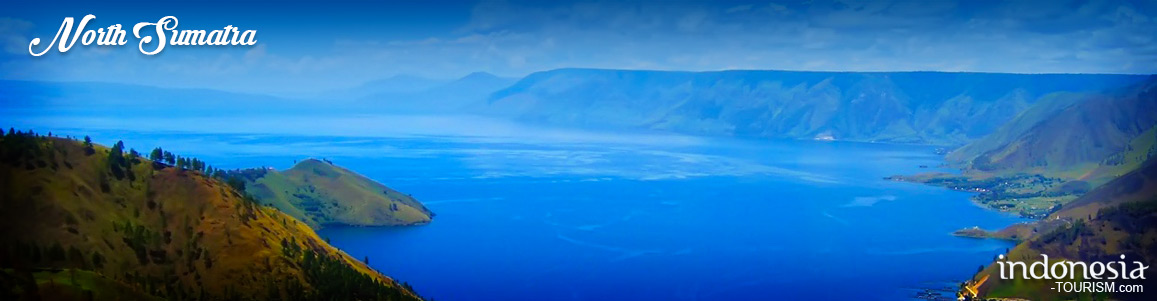
Lake Toba is indeed a favorite tourist destination when visiting North Sumatra. The charm of beauty offered in this lake area is indeed never ending to be explored. One of them is the uniqueness of the ‘lake above the lake’. This nickname is familiar to local people and tourists when mentioning Lake Sidihoni, which is in the Lake Toba area. This lake is located on Samosir Island, which is an island in the middle of Lake Toba. That’s why, this lake nicknamed is the ‘lake above the lake’. Here are…
Sirombu Beach: The Most Beautiful Beach in West Nias
For those of you who come to Nias Island for your next vacation, it is better to find information about attractions that were previously available. As for reference, the beautiful beach is in West Nias Regency named Sirombu. Usually tour agents will recommend this place to locals and foreigners. The reason is none other than the sunset view. In addition, Sirombu Beach is also equipped with amazing facilities and surroundings. Not surprisingly, many people consider it the best vacation spot in West Nias Regency. It is true that Sirombu Beach…
The Grandiose Toba Lake in North Sumatra Province
What makes Indonesia is a worthy vacation destination? Many travelers are impressed by nature beauty of the country. Moreover, there is a famous tourist spot in North Sumatra Province, which is called Toba Lake. Being the biggest lake in Indonesia, Toba becomes the signature tourism in Sumatra Island. It is because the flawless nature and pristine water would satisfy all visitors. People come to the lake to enjoy a family recreation, sightseeing, photography, and exploration. The fact is many different tourist spots are scattered around the lake. Tourists can explore…
Bohorok Rehabilitation Center, A Shelter for Orangutan
Bohorok Rehabilitation Center Bohorok Rehabilitation Center is a shelter for Orangutan in Sumatra that settled in Bukit Lawang. Bukit Lawang is one of the top destinations in Sumatra; Bukit Lawang is a small village on the edge of Gunung Leuser National Park in North Sumatra. Situated around 90 km north-west of Medan along the clear Bohorok River and on the outskirts of the tropical rainforest. As we know, The Gunung Leuser National Park is also one of the homes to Orangutan that spread in entire Sumatra Island. Thomas Leaf monkeys, Black Gibbons, White…